Why Fun Matters: Quotes and Science on Play for Kids
Ask most adults what they remember about being ten years old and you will rarely hear about a test score. You will hear about a treehouse, a bike ride at dusk, a joke that made the whole lunch table laugh. Fun is not the filler between the important parts of childhood. For a kid, fun is one of the important parts.
Somewhere along the way, "fun" got a bad reputation — treated as the reward you earn after the serious things are done. The research says the opposite. Play and joy are how children learn, how they recover from stress, and how they build the stamina to keep going when things get hard.
These ideas pair naturally with the lessons in 120 Positive Quotes for Kids, a collection written to help young readers ages 8–14 build confidence, resilience, and a healthy relationship with effort.

What the Research Actually Says About Play
In 2018 the American Academy of Pediatrics published a clinical report called The Power of Play, and its conclusion was blunt enough to surprise a lot of parents: play is so essential to healthy brain development that pediatricians should write "prescriptions for play" at well-child visits.
The report found that play helps children build executive function — the mental toolkit for planning, focusing, and controlling impulses — and that it buffers the effects of stress. Not as a nice extra. As a core developmental need.
Dr. Stuart Brown, a physician who spent decades studying play, put it in a line that sticks:
"The opposite of play is not work — it is depression."
That reframe matters. When a child's week has no room for joy, the problem is not that they are missing a treat. Something they actually need has been removed.
Mister Rogers on Play as Serious Business
Fred Rogers spent his whole career defending the seriousness of childhood fun:
"Play is often talked about as if it were a relief from serious learning. But for children, play is serious learning."
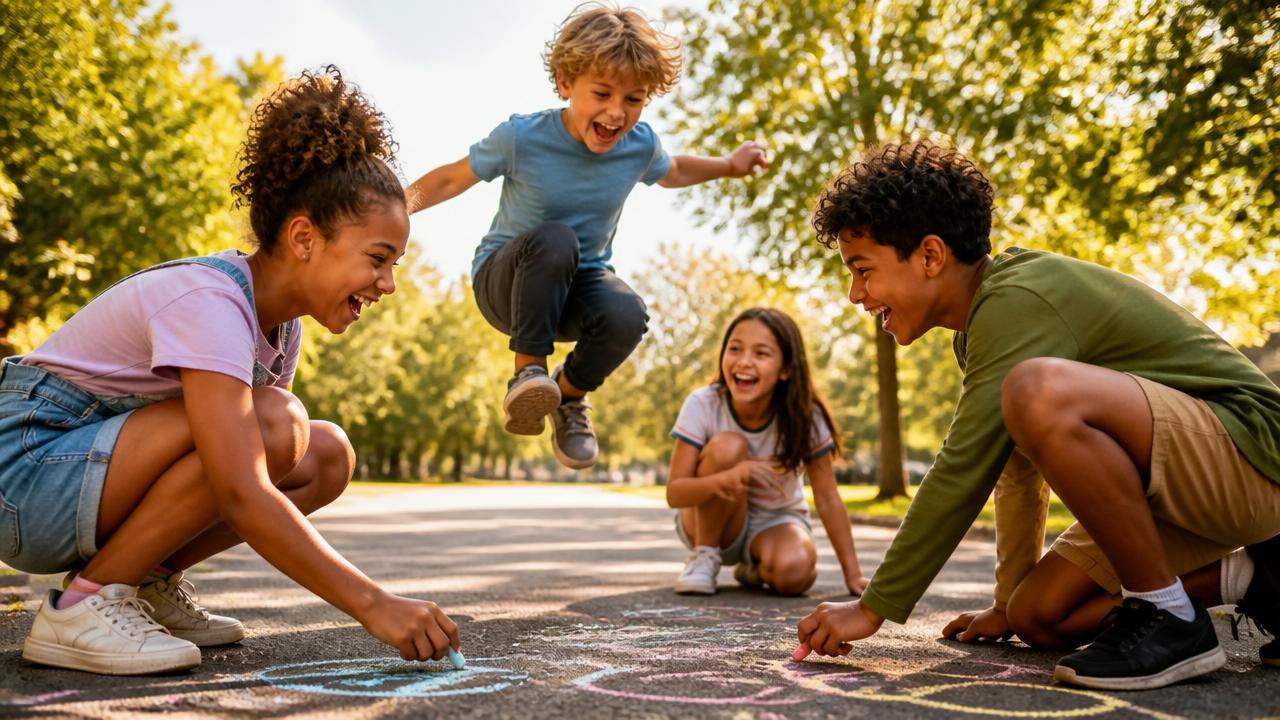
Watch a group of kids invent a game in a driveway and you will see negotiation, rule-making, fairness disputes, strategy, and repair after conflict — all in about four minutes. Nobody assigned it. Nobody graded it. They learned it because it was fun enough to keep doing.
Fun Is What Makes Practice Survivable
Here is the practical case for fun that every coach and music teacher already knows: kids get good at the things they enjoy long enough to get good at.
Talent rarely decides who sticks with the violin, the pool, or the chessboard. Enjoyment does. A child who laughs at practice shows up next week. A child who dreads it starts inventing stomachaches. Fun is the fuel that makes repetition possible, and repetition is what builds skill.
Mary Poppins gave children the shortest possible version of this idea, and it holds up:
"In every job that must be done, there is an element of fun."
Finding that element is a skill worth teaching. Racing the timer while cleaning a room. Turning spelling words into a silly song. Making the last ten minutes of homework a competition against yourself. None of it makes the work disappear — it makes the work bearable, and then repeatable.
Yogi Berra and the Joy of Not Taking Yourself Too Seriously
Yogi Berra won ten World Series titles as a New York Yankees catcher, and he did it while making the whole dugout laugh. His famous tangled sayings — "It ain't over till it's over" — were part of a personality that refused to be grim about a game.
Kids need permission for this. Many children ages 8 to 14 quietly believe that being serious is the same as being good. It isn't. Some of the most accomplished people in history were the ones goofing around between attempts, and the goofing around is part of why they lasted.
Plato on What Play Reveals
A line commonly credited to Plato — a paraphrase of a passage in The Republic, rather than a direct translation — says:
"You can discover more about a person in an hour of play than in a year of conversation."
Whether or not the wording is his, the observation is true, and parents can use it. If you want to know how your child handles losing, being left out, being in charge, or being wrong, do not interview them. Play a game with them. Everything shows up.
Fun Is Not the Same as Screens
An honest note, because kids will raise it: not all fun is equal. Two hours of scrolling and two hours of building a fort both feel like fun in the moment, but only one of them leaves a child energized afterward.
A simple test kids can apply themselves: How do I feel when it is over? Real play usually leaves you tired-but-good, with something to show or a story to tell. Passive entertainment often leaves you flat and a little grouchy. Teaching children to notice that difference is more useful than any screen-time rule you will ever enforce.
Simple Ways to Protect Fun at Home and School
1. Leave unscheduled time on the calendar. Boredom is the doorway to invented games. A completely booked week has no door.
2. Play *with* them, not just near them. Twenty minutes of a card game beats an hour of supervised screen time — for both of you.
3. Let the fun be pointless. Not every activity needs to build a skill or fill a résumé line. Some things are worth doing because they make a kid laugh.
4. Put humor in hard moments. A joke after a rough game does not dismiss the disappointment; it reminds a child that the day is bigger than the loss.
5. Model it. Kids who never see adults enjoying themselves conclude that adulthood is something to dread. Let them catch you having a good time.
Fun and Grit Are Teammates, Not Rivals
It is tempting to treat fun and discipline as opposites — as if every laugh comes out of the effort budget. In practice they support each other. Children who enjoy the process build grit almost by accident, because they keep coming back. Children who only ever grind eventually stop.
Dr. Seuss, who understood children better than most, is often credited with the simplest possible summary:
"Fun is good."
Two words, and hard to argue with.
If your child responds to short, memorable lines like these, 120 Positive Quotes for Kids collects 120 of them — each paired with a plain-language reflection — to help kids ages 8 to 14 build confidence, resilience, and the kind of joy that keeps them going.
Because the goal was never to raise a child who works the hardest. It was to raise one who is still glad to be here on a Tuesday afternoon.